The short answer: A niche edit, also called a link insertion, is a link added to an article that is already published on another site, rather than a new article written to carry it. Because the page already exists, you can inspect it before you agree. Google's spam policy covers buying links for ranking purposes, whether they appear in new articles or existing ones. Paid advertising or sponsorship links can comply with that policy when appropriately marked rel="sponsored" or rel="nofollow". Before paying, get the exact host URL, the link attribute and the removal terms in writing.
- Definition: a niche edit adds your link to an existing, published article instead of a new one.
- Inspectable: the host page is live already, so you can check its topic, indexing and other outbound links before you pay.
- Policy: a paid link that passes ranking credit is link spam under Google's policy; qualified with sponsored or nofollow, it is not.
- Price: one seller's list runs from $119 to $237 per placement by DR band; that is one price list, not a market rate.
- After it goes live: confirm the link, anchor, destination and rel value, and record the date you checked.
What Is a Niche Edit?
A niche edit is a link added to an article that is already published on someone else's site, instead of a new article written to carry the link. The site owner or editor edits an existing page so that a sentence, or a short new passage, links to your page. Sellers also call it a link insertion.
Sellers usually present the age of the host page as the selling point: it may already be indexed, it may have traffic, and you can inspect it before you pay. Those are things you can check. Whether the edit will help your rankings is not something anyone can promise. When you have one live, record it in your backlink management software alongside your other placements.
How Does a Niche Edit Work?
Most offers follow the same five steps, whether you arrange the edit yourself or through a seller.
- You give the target and the anchor. You name the page you want linked and the words you would like the link on.
- A host page is chosen. Someone looks for a published article on a related topic. Sellers often filter by domain metrics and estimated traffic.
- The site owner agrees. The owner or editor accepts the change. In paid offers this is where money changes hands.
- The text is edited. Your link goes into an existing sentence, or a sentence is added around it.
- You get the live URL. The seller reports the page address, and often the anchor and domain metrics.
Process descriptions: Vettted and niche-edits.com, read November 2, 2026. These are sellers' own descriptions, not verified fulfilment.
Niche Edits vs Guest Posts
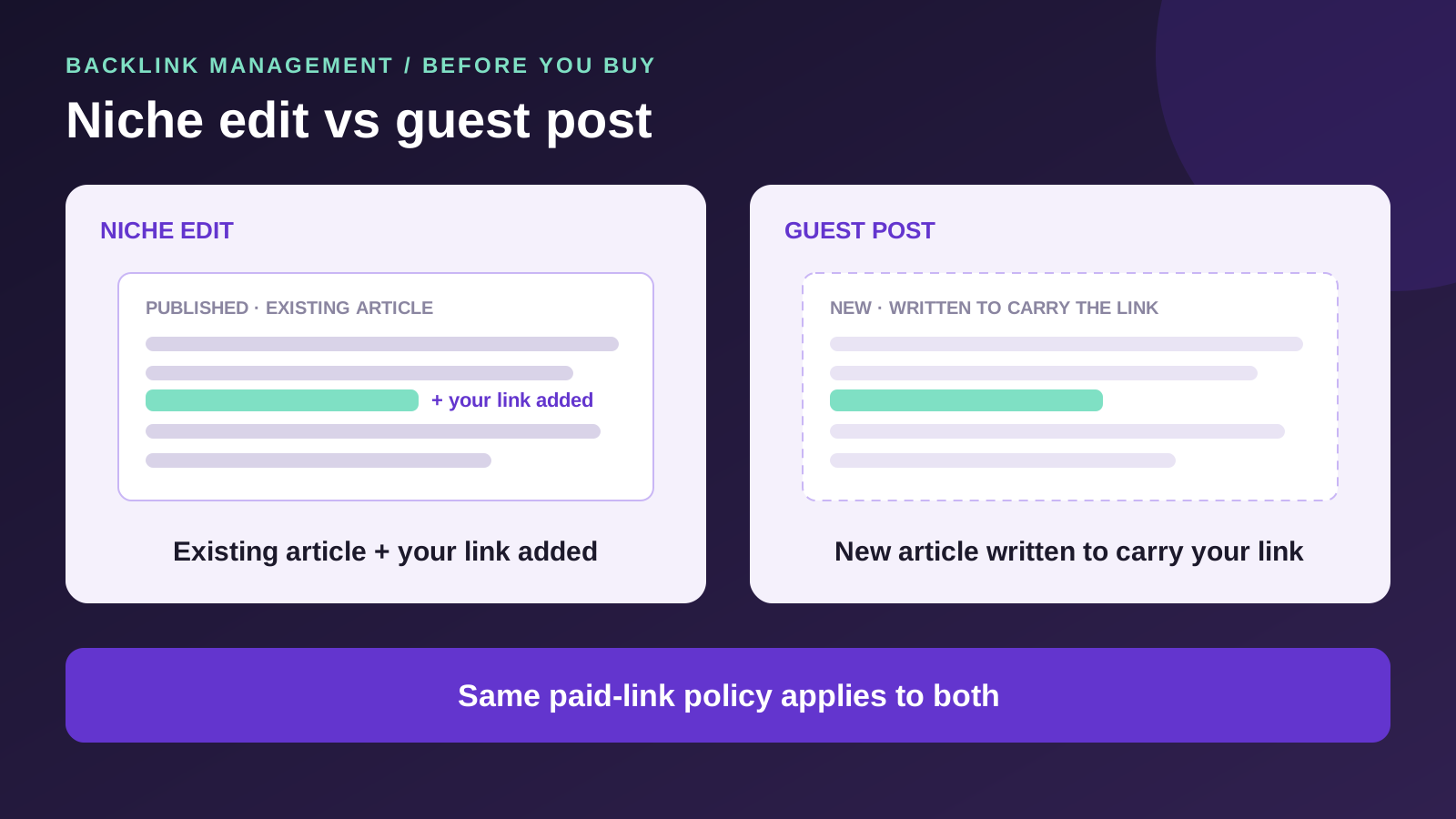
The difference is whether a new article is published. A guest post is a new article, written by you, the seller or the publisher, that carries your link. A niche edit adds your link to an article that already exists.
- Content: a guest post needs a new article; a niche edit changes an existing one.
- What you can inspect before buying: with a niche edit, the host page is live already, so you can read it, see its other outbound links and check whether it is indexed. With a guest post you can inspect the site, but the page does not exist yet.
- Context: a niche edit has to fit text that was written for another purpose. A guest post can be written around your topic.
- Policy: Google's rules are the same for both. Payment for a link that passes ranking credit is link spam whether the link sits in a new post or an old one.
Our comparison of PBN links vs guest posts covers who controls the site behind each kind of offer.
Are Niche Edits Against Google's Guidelines?
A paid niche edit that passes ranking credit falls inside Google's definition of link spam. Google lists "exchanging money for links, or posts that contain links" as an example, and the policy covers links created "primarily for the purpose of manipulating search rankings."
- Allowed: Google says buying and selling links for advertising and sponsorship is not a violation when the link is qualified with
rel="sponsored"orrel="nofollow". - Not allowed: a paid insertion marked as an ordinary followed link.
- Not established: Google does not publish how often paid links are detected, so we cannot give you a risk percentage.
An unpaid edit is a different situation. If an editor adds your link because your page is a useful source, that is an editorial decision. Page One Power points to broken link building, unlinked mentions and resource pages as ways of earning a link on an existing page without paying for it.
Sources: Google spam policies, Qualify your outbound links and Page One Power's niche edits glossary entry, all read November 2, 2026.
What Do Niche Edits Cost?
There is no reliable market rate, and one seller's price list is not a survey. As one example, niche-edits.com lists $119 per placement on DR 10–29 sites, $181 for DR 30–49 and $237 for DR 50–90.
Source: niche-edits.com pricing, read November 2, 2026. We did not buy from this seller or verify delivery.
Price does not tell you whether the link is qualified, whether the host page is indexed or how long the link will stay. Compare offers on those terms, not on cost per link.
How Do You Check a Niche Edit Before You Pay?
Ask for the exact host page URL before you agree, then check it yourself.
- The page is discoverable in Google. Search for its exact URL or a distinctive passage. Finding it in results is useful evidence; not finding it does not prove it is unindexed. Ask the publisher for stronger evidence where indexation is a material purchase condition.
- The topic fits. Your link should make sense to someone reading that article.
- Other outbound links. A page that links to many unrelated commercial sites may be selling placements. Treat that as a warning sign and investigate before paying.
- The link attribute. Ask whether the link will carry
sponsored,nofollowor neither, and get the answer in writing. - Who controls the site. Ask whether the seller owns the site, works for it or resells it.
- What happens if it disappears. Ask for the live period and the replacement or refund terms in writing.
Our list of guest post site red flags covers more warning signs, and most of them apply to niche edit sellers too.
What Should You Do After the Link Is Live?
Open the page and confirm four things: the link is there, the anchor is what was agreed, it points to the right page, and its rel value matches what you were told. Our guide on how to check if a backlink is dofollow shows how to read the attribute and page-level robots rules.
Then write down what you saw and the date. An edit to an old article can be undone just as quietly, so keep the agreed terms next to your own dated observation. Backlink Management is backlink management and tracking software for SEO agencies, link builders and site owners, founded by Brandon King and based in Miami, Florida. Backlink Management lets you organise placement records alongside connected Google Search Console data. It does not automatically re-check placements or alert you when links disappear.
BACKLINK MANAGEMENT
Keep Your Backlink Records and Search Data Together
Record placements alongside connected Google Search Console data in Backlink Management.
Questions
Niche Edit Questions
Yes. Sellers use both names for adding a link to an article that is already published.
That depends on the arrangement. A paid link that passes ranking credit falls inside Google's link spam policy; a paid link marked sponsored or nofollow does not. We cannot give you a detection rate, because Google does not publish one.
Neither is better by default. A niche edit lets you inspect the host page first; a guest post can be written around your topic. Both fall under the same paid-link policy.
No. Our marketplace lists guest posts, where you submit your own article. You can record any placement, including a niche edit you arranged elsewhere, in your Backlink Management workspace.
Where this lands
Verdict
- Who this suits
- Site owners and agencies who have been offered a niche edit and want to understand the arrangement, the policy and the checks before paying.
- Who it does not suit
- Anyone looking for a seller recommendation, a guaranteed ranking effect or a typical price.
- What we could not verify
- We did not buy a niche edit or test any seller's delivery. The pricing example is one seller's published list, read November 2, 2026.