The short answer: An editorial backlink is a link a publisher chooses to include because another page provides useful evidence, expertise or context. The publisher controls whether to cite it. You can earn these links through useful resources, original research and outreach, but you cannot guarantee an independent editorial decision. Paid guest posts and sponsored insertions are different commercial arrangements, even when the resulting content looks editorial. Paying a PR agency to research or pitch a story does not by itself make a resulting citation a paid placement: paying for the service and paying to secure the link are different arrangements.
- Definition: an editorial backlink is a link a publisher chooses to give; it is an industry term, not a Google category.
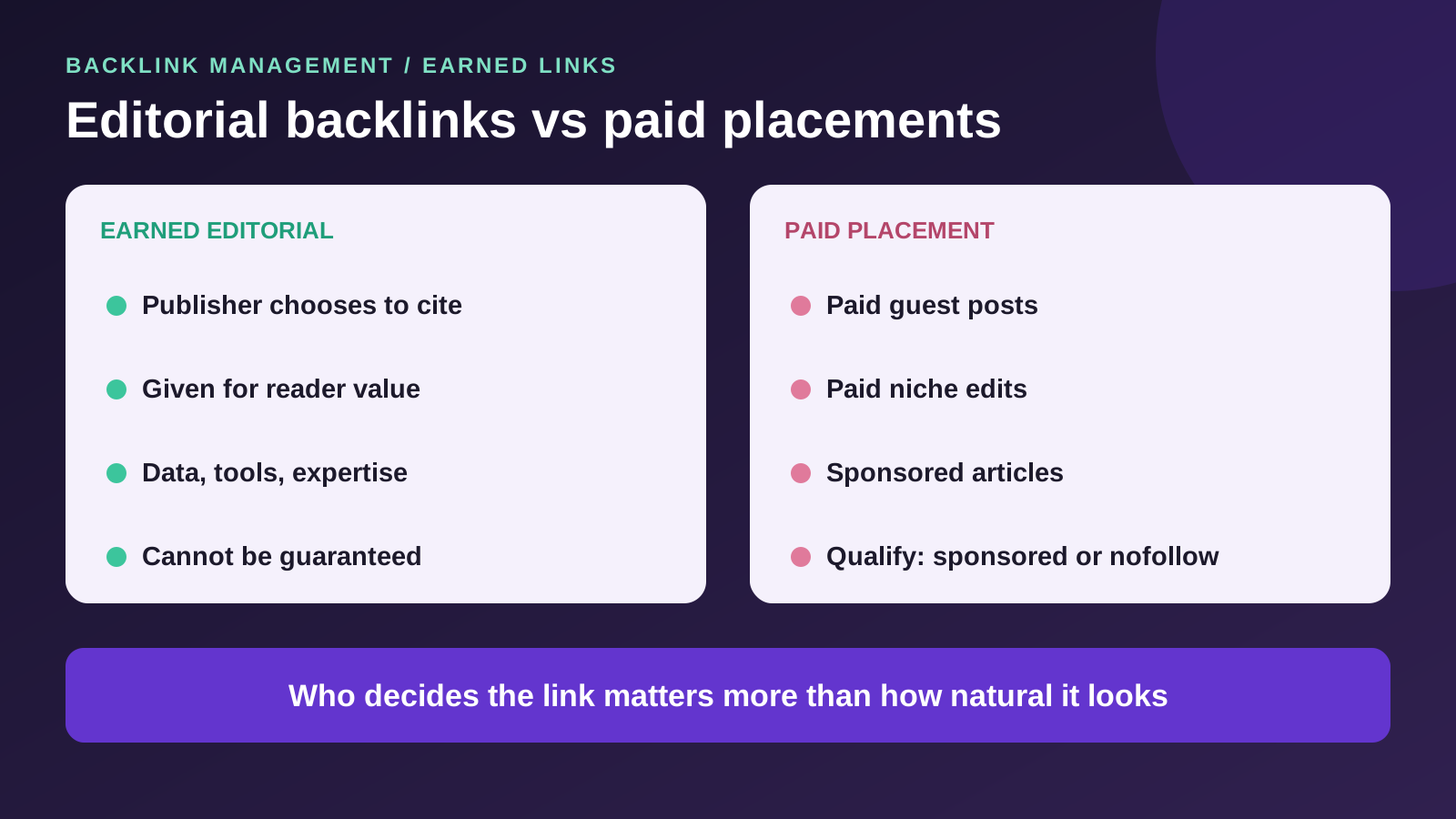
- Not the same as paid: paid guest posts, paid niche edits and sponsored articles are commercial arrangements, even when they read naturally.
- Policy: Google treats paid links that pass ranking credit as link spam and expects paid placements to carry rel="sponsored" or rel="nofollow".
- Earning them: fill a specific publisher's evidence gap with data, tools or expertise, pitch the finding and leave the decision to the editor.
- Vetting: ask whether a service sells outreach work or predetermined links before you pay.
What Are Editorial Backlinks?
An editorial backlink is a link a publisher chooses to include because your page gives their readers useful evidence, expertise or context. The editor decides whether to cite you, which page to link and how the link is treated. Nobody is contractually owed the link.
"Editorial backlink" is an SEO industry term, not a Google category. Google defines link spam, not editorial links. Industry providers draw the same line, though: EditorialBacklinks.com says journalists and publishers "make the final decision" and that a provider "cannot honestly guarantee earned coverage."
Three illustrative examples (not Backlink Management case studies):
- Original data: a journalist writing about remote-work costs cites a company's published survey and links to the methodology page.
- A useful tool: an industry writer explaining SEO budgets links to a free calculator that lets readers run their own numbers.
- Expert commentary: a publisher quotes a specialist in an article and links to the specialist's page on the topic.
In each case the link exists because it helps the reader, and the publisher could have left it out.
Source: EditorialBacklinks.com, Editorial Backlinks and Journalist Outreach Services, read 16 November 2026. This is a provider's own description of its services, not a controlled test.
Editorial Backlinks vs Guest Posts, Sponsored Links and Niche Edits
These labels describe different things: who controls the link, what format the content takes and whether payment secures the placement. A link can sit naturally inside well-written text and still be a paid placement.
| Arrangement | Who decides? | What distinguishes it? |
|---|---|---|
| Earned editorial citation | Independent publisher | Link given for reader value |
| Unpaid guest contribution | Publisher approves the submission | A contributed article; a link is not automatic |
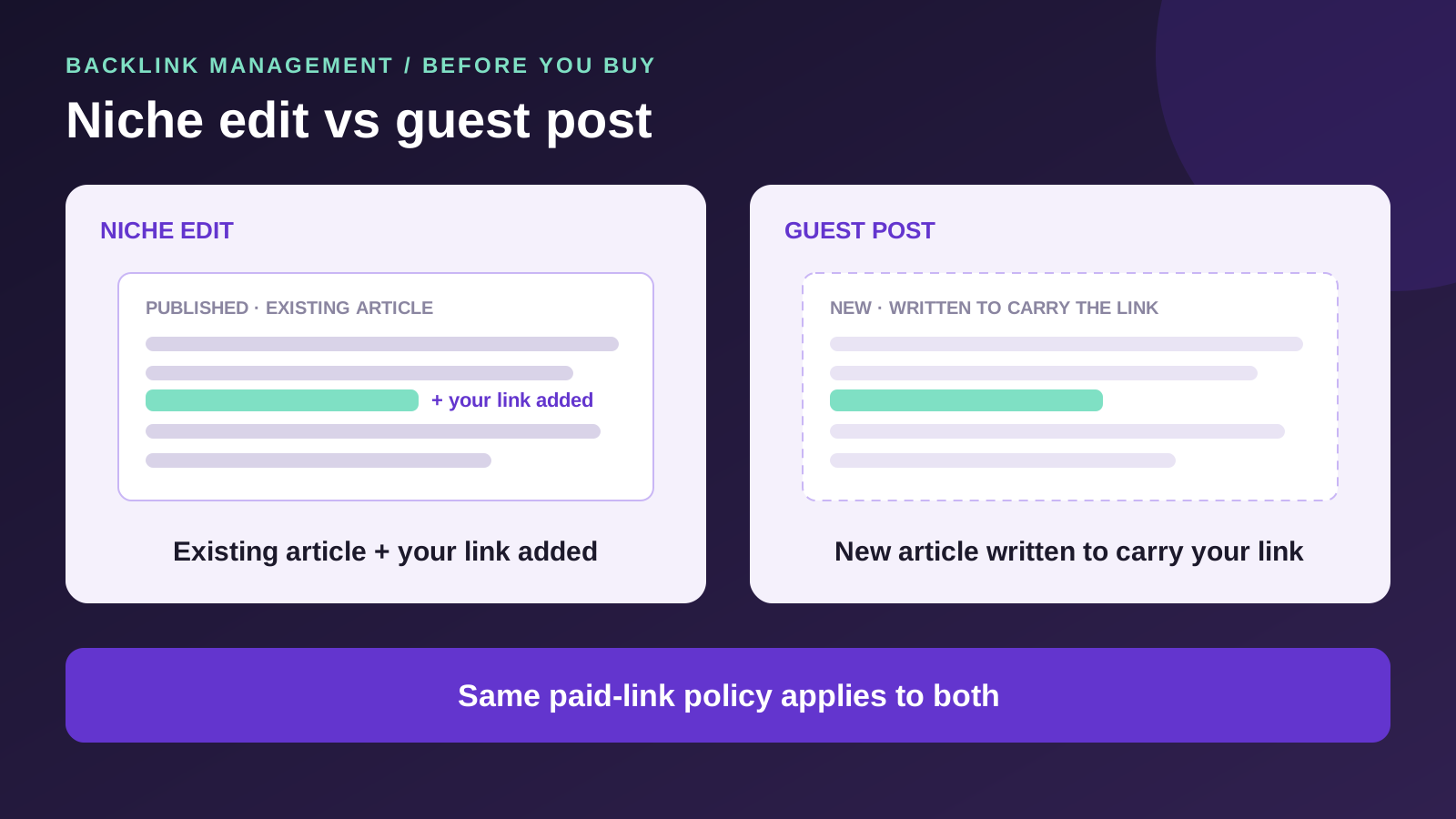
| Paid guest post | Commercial arrangement plus publisher approval | New article and paid placement |
| Paid niche edit | Commercial arrangement plus publisher approval | Link added to an existing article |
| Sponsored article | Commercial arrangement | Promotional content with appropriate disclosure and link qualification |
Not every guest post is paid, and not every link added to an existing article is paid. What matters is whether the publisher chose the link independently or the placement was bought. Our guide to niche edits covers links added to existing articles, and our comparison of PBN links vs guest posts covers who controls the site behind each kind of offer.
Can You Buy Editorial Backlinks?
You can pay for outreach, writing, digital PR or a publisher placement. Paying to secure a specific link, however, is not the same as a publisher's independent choice to cite you.
That is why the phrase "buy editorial links" deserves scrutiny. A publisher may still edit a paid article and reject weak submissions, but editing alone does not turn a paid placement into an earned endorsement.
There are two different payments to separate:
- Paying for the work: a PR agency researches a story, writes the pitch and contacts journalists. If a journalist then cites you, the journalist made that choice. The fee bought the work, not the link.
- Paying for the link: money reaches the publisher, or a seller, in exchange for a guaranteed placement. That is a paid link, however the seller labels it.
SerpLogic, a provider of editorial link services, answers the question "Can you buy editorial backlinks?" with "You can pay for outreach and placements". A buyer still needs to know which of the two arrangements a given offer is.
Source: SerpLogic, How to Get Editorial Backlinks, read 16 November 2026. Quoted as a live example of how a commercial provider frames the question, not as evidence of results.
What Does Google Say About Paid Editorial Links?
Google treats links bought primarily to manipulate rankings as link spam. Paid advertising and sponsored links are allowed when they are qualified with rel="sponsored" or rel="nofollow".
Google's spam policy describes link spam as "creating links to or from a site primarily for the purpose of manipulating search rankings." Its examples include advertorials and native advertising "where payment is received for articles that include links that pass ranking credit", and links with optimised anchor text in guest posts distributed on other sites.
The same policy says Google "does understand that buying and selling links is a normal part of the economy of the web for advertising and sponsorship purposes." Such links are not a violation when qualified. Google's link-qualification guidance asks publishers to mark "advertisements or paid placements (commonly called paid links)" with sponsored.
Being contextual, well written or labelled editorial does not change that. Google does not publish how often paid links are detected, so we can't give you a risk figure.
Sources: Google spam policies: link spam and Qualify your outbound links, both read 16 November 2026.
How Do You Earn Editorial Backlinks?
You earn them by giving a specific publisher something its readers need and leaving the citation decision to the editor. This is a practical process, not a formula with a guaranteed rate.
- Find an evidence gap. Look for articles in your field that make claims without a source, use outdated figures or explain something a reader can't act on.
- Create or point to an asset that fills it. That might be original data, a calculator, a benchmark, specialist commentary or a practical reference.
- Find the right person. Pitch the writer or editor who covers that topic, not a general inbox.
- Pitch the finding, not the link. Explain what your asset shows and why it helps their readers. Don't ask for a particular anchor.
- Respect the answer. The editor decides whether to cite you, and how.
Journalist requests for expert sources are another route: you answer a writer's question with real expertise, and they choose whether to quote and link you. Our guide to permanent backlinks covers what to agree when a link does need to stay live for a set period.
How Should You Vet an Editorial Link Building Service?
First establish what the service sells: research and outreach work, or predetermined links. Both exist, and they are different products with different risks.
Ask any provider:
- Named publications: which sites have published its clients' work recently, with live URLs you can open?
- Editorial independence: does the publisher decide whether to cite, or is the placement agreed in advance?
- Payment model: are you paying for work, for results, or does money reach the publisher?
- Guarantees: a guaranteed link on a named site is a placement, not earned coverage.
- Link attributes: will paid placements carry
sponsoredornofollow? Get it in writing. - Relevance: is the source page about your topic, and would its readers care about your page?
- Refund terms: what happens if nothing is published, or a link disappears?
- Delivery evidence: can it show you the live page, not just a report?
Prices vary because services sell fundamentally different deliverables, so we don't publish an average editorial link price. Our list of guest post site red flags covers warning signs that apply to many link sellers.
Where Do Guest Post Marketplaces and Backlink Management Fit?
Backlink Management's marketplace sells paid guest-post placements, not earned editorial backlinks. After signing up, buyers choose from available publisher listings and order one-time placements.
Backlink Management is backlink management and tracking software for SEO agencies, link builders and site owners, founded by Brandon King and based in Miami, Florida. If you want to buy a paid placement, the guest post marketplace lets registered users browse publisher listings before ordering.
Whether a link was earned or bought, our backlink management software helps you organise backlink records alongside connected Google Search Console data. It does not re-check links, send automatic loss alerts, keep an audit history or store a per-placement cost field, so checking that each link is still live stays with your team.
BACKLINK MANAGEMENT
Know Which Kind of Link You Need?
Browse one-time guest post listings, choose a suitable publisher and manage your placement order in Backlink Management.
Questions
Editorial Backlink Questions
No. The publisher decides how to treat the link, and some publications add nofollow to outbound links as a matter of policy. A nofollow citation can still send readers to your page. Check the attribute on the live page.
Yes. Pitching a useful finding to the right writer is a normal way to earn a citation. It stays editorial as long as the publisher decides independently whether to link, and no payment secures the placement.
Not automatically. An unpaid guest contribution is approved by the publisher, but a link in it is not guaranteed. A paid guest post is a commercial placement, and Google expects paid links to be qualified with sponsored or nofollow.
A paid link that passes ranking credit is link spam under Google's policy, whatever it is called. A paid placement qualified with rel="sponsored" or rel="nofollow" is not a violation.
There is no reliable timeline. It depends on the asset, the publication and whether a writer is covering the topic. Anyone promising a fixed delivery window for earned coverage is describing something closer to a placement.
No. Backlink Management's marketplace sells paid guest-post placements that registered users choose from available listings. It does not sell earned editorial citations. Its workspace helps you organise backlink records alongside connected Google Search Console data.
Where this lands
Verdict
- Who this suits
- Teams that want independent coverage and can create data, tools or expertise worth citing, plus buyers who need to tell earned citations apart from paid placements.
- Who it does not suit
- Anyone expecting a guaranteed editorial link on a named site, or treating a paid placement labelled editorial as an earned endorsement.
- What we could not verify
- We did not buy a placement, test a PR campaign or measure a ranking change.