At a glance · sources read 16 September 2026
Four Events That All Get Called “Removed”
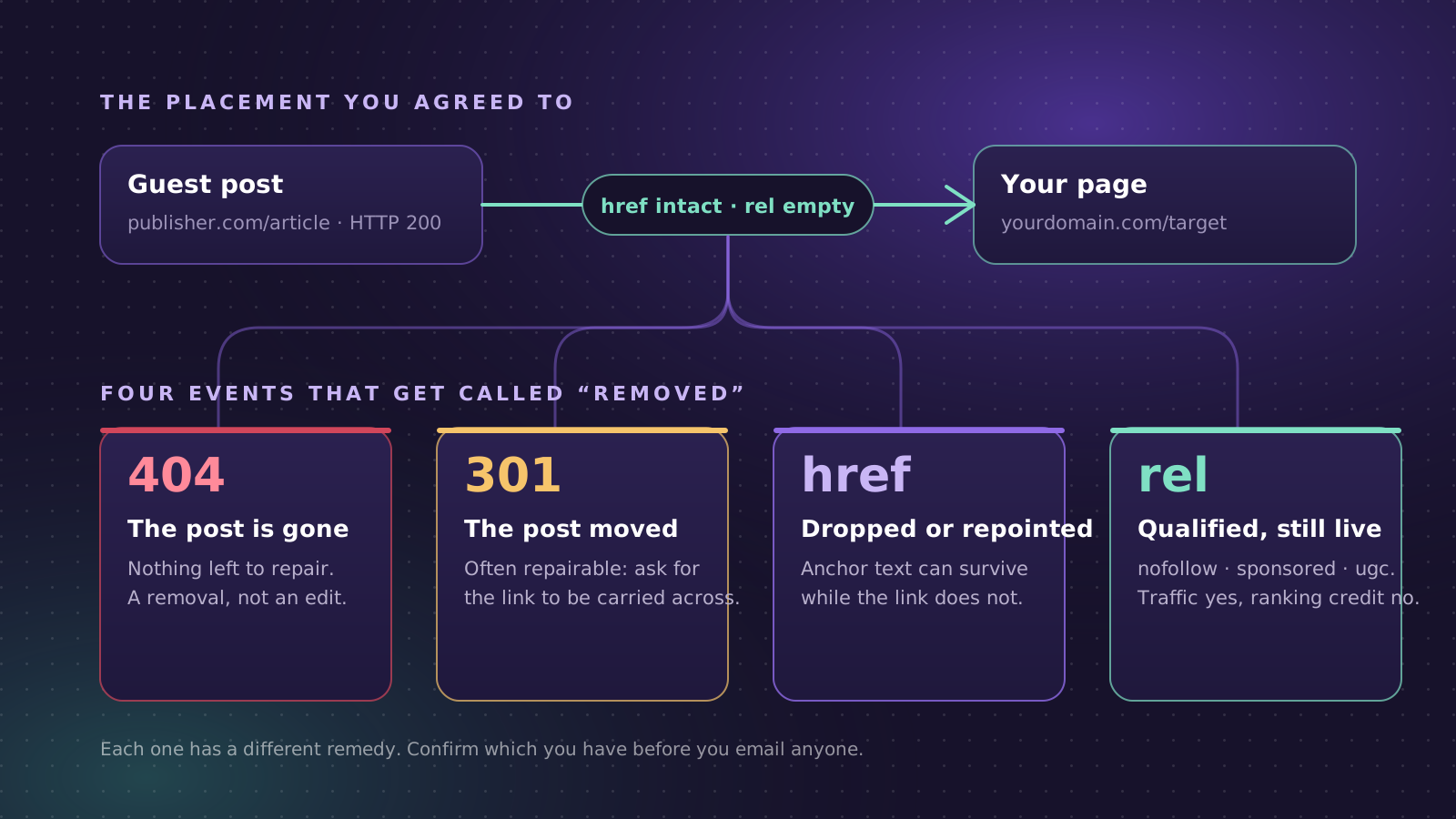
Confirm which one you have before you email anyone. Each has a different remedy, and one of them has none.
- 404the post is gone
- Nothing left to repair. A removal, not an edit.
- 301the post moved
- Often repairable: ask for the link to be carried across.
- hrefdropped or repointed
- Anchor text can survive while the link does not.
- relqualified, still live
- nofollow, sponsored or ugc: traffic yes, ranking credit no.
- 6things to keep
- Order record, URL, date live, archive, raw HTML, contact thread.
- 72hrepair window
- One vendor’s advertised terms, not a standard.
The short answer: find out what changed, not just that something did. Pull the live page, compare it against the placement you agreed to, and record both with a timestamp. Then decide whether you are asking for a repair, a replacement, a refund, or nothing — and whether the terms you bought under give you the right to ask.
- Diagnose before you complain: a "removed" link is usually one of four events — the page is gone, the href was dropped, the href was repointed, or the
relattribute changed. Each has a different remedy. - Read the raw HTML, not the rendered page: view source and search for your domain. The anchor text can survive while the
hrefdoes not. - Keep the original evidence: the delivered URL, the date it went live, an archived copy, the agreed anchor and target URL, and the order record. Without a baseline you cannot show what changed.
- Google treats a paid link that passes ranking credit as link spam, and its documentation names unqualified paid advertorial links as an example (Google Search Central spam policies, read 16 September 2026).
- Repair windows are vendor terms, not a standard: one recovery vendor publishes a 12-month window for guest posts, six months for link insertions and a 72-hour repair window (BlogReach vendor page, read 16 September 2026). Those are promises, not measured outcomes.
- What we could not verify: no published removal rate, no restoration rate, and no independent dataset covering more than a single thread and one vendor page. Nothing on this page is a success-rate estimate.
Quick Facts
- Distinct events to check: 4 (gone, moved, href, rel)
- Pieces of evidence to keep per placement: 6
- Vendor window quoted: 12 months guest post, 6 months insertion
- Repair request window quoted: 72 hours
- Removal rate published: none found
- Sources read: 16 September 2026
- Vendor windows are that vendor's advertised terms and are not verified outcomes.
Four Things That Look Like a Removed Link
Owners usually discover the problem by accident — a routine audit, a client question, or a rankings drop they then attribute to the link. That is why the first step is not contacting anyone. It is establishing what the page looks like right now.
The four possibilities below cover almost everything that reaches the word "removed":
What changed, how to confirm it, and what it means for your options.
| What changed | How to confirm it | What it means |
|---|---|---|
| The post is gone | The URL returns 404 or 410, or it now serves an unrelated page. | There is no placement left to repair. This is a removal, not an edit. |
| The post moved | The URL 301s to a new address; check whether your link survived the migration. | Often repairable. Ask for the link to be carried across, or ask for the canonical target. |
| The href was dropped or repointed | Search the raw HTML for your domain, then compare the href with the target URL you agreed on. | The anchor text may still name your brand with no link behind it, or the link may now point somewhere else. |
The rel attribute changed | Inspect the anchor and read its rel value: nofollow, sponsored or ugc. | The link is still there and still sends referral traffic. It simply no longer passes ranking credit. |
The distinction between the third and fourth rows is the one people get wrong. A link that has had a sponsored or nofollow attribute added is still a live anchor; a link whose href was stripped is not a link at all. Treating them as the same event will produce a repair request the publisher can correctly refuse.
Diagnose It in One Pass
Work through these in order and keep the output. Each step produces something you can attach to a repair request later, which is the real point of doing it this way.
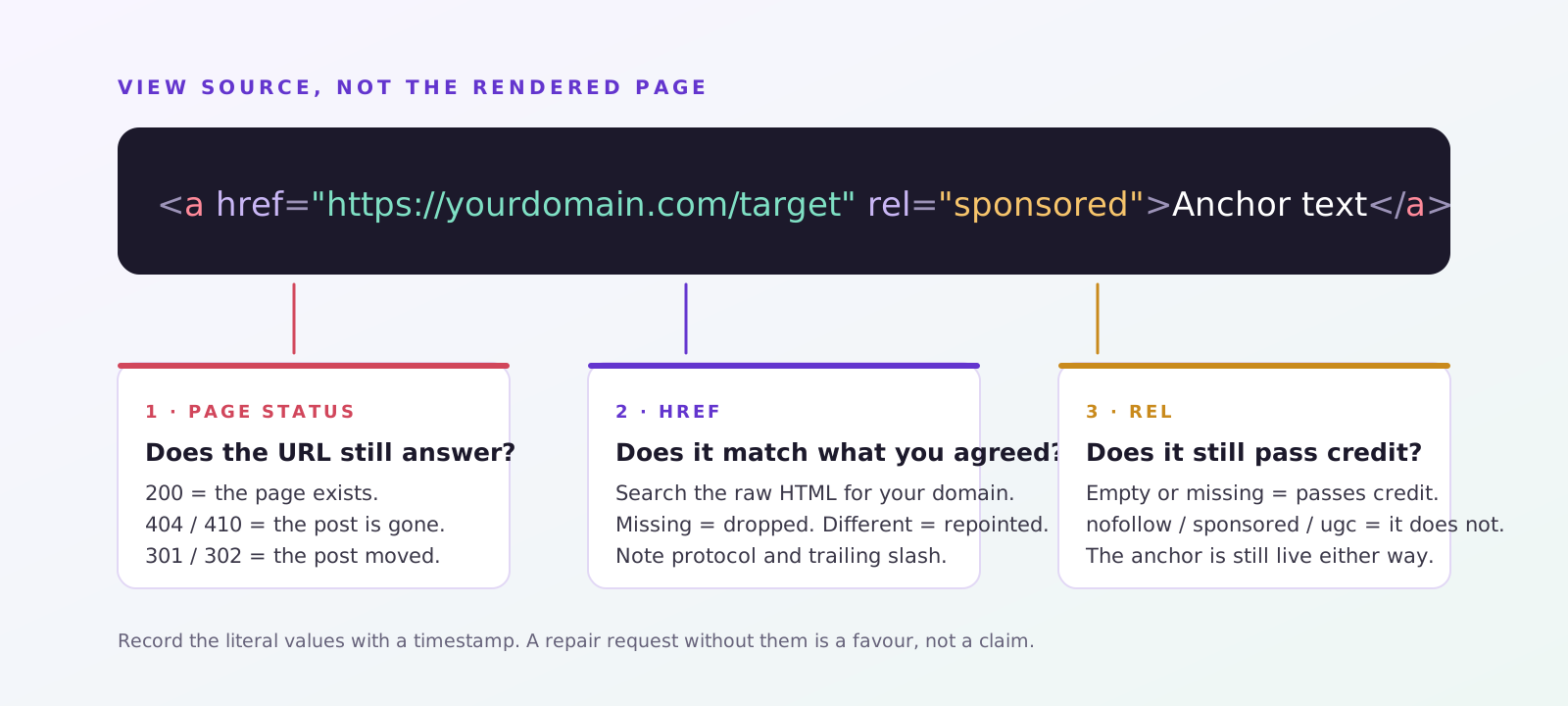
- Load the URL and record the HTTP status. A 200 means the page exists; a 404 or 410 means the post is gone; a 301 or 302 means it moved. If the status is not 200, jump straight to the repair-or-refund question below.
- View source, not the rendered page. Browser extensions and rendering can hide the difference between an anchor and plain text. Search the raw HTML for your domain name and confirm whether an
<a href>actually contains it. - Compare the `href` with what you agreed to. Right page, wrong URL is a common and easily fixed outcome. Note the exact target, including trailing slash and protocol.
- Read the `rel` attribute on that anchor. An empty or missing
relpasses credit; nofollow, sponsored or ugc does not. Record the literal value rather than describing it from memory. - Diff the live page against your archived copy. If the article body was rewritten, you can usually tell whether the link was deliberately stripped or lost in an edit.
- Save the evidence with a timestamp. Keep the raw HTML, a screenshot showing the URL and the page, and a note of the date. Do this twice, a few days apart, so you are reporting a settled state.
Method: our own diagnosis sequence. It is deliberately a record-keeping exercise, not a legal or contractual analysis. Nothing here establishes what a publisher owes you.
Two Mistakes That Waste the Whole Exercise
Both are common, and both destroy your credibility with the publisher before you have made your case.
- Treating a nofollow link as deleted. The anchor is present and can send referral traffic. It has lost ranking credit, which is a different complaint with a different fix.
- Reading anything into missing `site:` results. The operator is not a reliable test of whether a specific URL is indexed. Use URL Inspection on that one URL instead of inferring from a site-wide query.
There is also a third mistake that costs money rather than credibility: asking the publisher to strip a sponsored or nofollow qualification so the link "counts" again. Google's spam policies name paid links that pass ranking credit, and unqualified paid advertorial links, as link-spam examples. Asking a publisher to remove the qualification is asking them to create the problem the policy describes.
Source: Google Search Central, spam policies, link spam section — developers.google.com/search/docs/essentials/spam-policies, read 16 September 2026. This is the primary authority for how paid links are classified. It says nothing about what any individual vendor owes you.
Capture the Placement Before You Need It
Every repair conversation is an evidence conversation. The party who can show what was published, where, and when, wins it — and that is usually the buyer, if they saved it at delivery time.
Six things are worth keeping for every paid placement:
- Order record: the invoice or receipt, with the agreed anchor text and target URL written on it.
- Delivered URL: the exact live address, not the domain.
- Date first seen live: with time and timezone, because coverage windows are counted in months.
- Archived snapshot: an independent archive of the live post showing the link in place.
- Raw HTML at delivery: so a later
relchange is provable rather than arguable. - Contact thread: the email or message where the placement was agreed.
Our recommendation, based on what the vendor terms below actually require as proof. No vendor named on this page was asked to confirm this list.
If you have none of that, you are not out of options — you are down to asking a favour. Do not spend the same effort on the request that you would spend with a baseline in hand.
Why Publishers Remove or Qualify Links
The motive usually has nothing to do with you. A publisher may be cleaning up the site, retiring thin posts, or responding to a review of their own paid-link practices. Editorial systems get rebuilt, and migrations lose links as a side effect.
The one scenario worth understanding properly is qualification. Google's spam policy treats paid links that pass ranking credit as link spam, and it also names unqualified paid advertorial links. A publisher who takes that seriously has a legitimate reason to add a sponsored or nofollow attribute or to take the link out entirely — and a request to undo it is a request to breach the policy the document sets out.
Source: Google Search Central spam policies, link spam section, read 16 September 2026. The policy document does not address commercial remedies, refunds or replacement obligations; those come from the vendor's own terms.
That is the honest framing to use internally. A paid placement that has been qualified is not a vendor failure by default, and a team that escalates every qualified link as a "removal" will eventually be ignored.
Repair, Replacement, Refund, or Nothing
Once you know what changed, there are four outcomes. Each has a different bar, and only one of them is worth spending time on by default.
What each one requires:
- Repair: the post still exists and the fix is small — restore the href, correct the target, or replace a retired URL with a live equivalent. Needs a baseline to be credible.
- Replacement: the post is gone or the publisher will not restore the link. Needs coverage-window terms that actually cover you, plus an equivalent page to place on.
- Refund: the terms provide a remedy and the claim deadline has not passed. Needs the invoice and the original placement record.
- Nothing: the link was qualified, the window expired, or the placement was never guaranteed in writing. Painful, but cheaper than a month of email.
What the terms can look like in practice — from one vendor's own published recovery page, not from a standard:
- Guest posts: a 12-month coverage window
- Link insertions: a six-month coverage window
- Repair requests: a 72-hour window to raise the issue
Source: BlogReach vendor page, blogreach.com/blog/why-guest-post-links-disappear, read 16 September 2026. These are the vendor's advertised terms describing its own monitoring workflow. They are not verified fulfilment results and they do not describe any other vendor's terms. Read your own agreement, not this one.
Note the shape of that offer rather than the numbers. The vendor is selling monitoring — you only discover the removal if something is checking on a schedule. Whatever you buy, the question to ask is who notices first, and how long after.
What One Public Thread Actually Shows
Search demand for this problem is real, and the public evidence is thinner than the number of articles about it suggests. The clearest primary source we found is a single forum thread.
- Where: Reddit, r/SEO.
- Title: "Site owner removed the backlink in my guest post. What to do?"
- Published: 8 February 2021.
- What the poster reports: the publisher replaced their link, and then stopped replying to them.
- Best reply: one commenter asks whether a contractual agreement existed at all, rather than recommending a remedy.
Source: reddit.com/r/SEO/comments/lfc2wy/site_owner_removed_the_backlink_in_my_guest_post/, thread published 8 February 2021, read 16 September 2026. Direct extraction was blocked, so the thread was read in a browser; the poster's account is their own claim and is not independently verified. No legal conclusion is drawn from it, and no commenter here is a lawyer.
Treat that as one dated anecdote, not as prevalence data. It does not tell you how often links are removed, and it does not establish that "publishers stop replying" is typical — it only shows that the failure mode of no written terms is a dead end. We found no Trustpilot rating or review count for any link-recovery vendor in this run, so none is reported.
Where Monitoring Fits into This
This is the part of the page where we are the vendor, so weigh it accordingly.
The reason a removed link is discovered late is almost always that nothing was checking. Backlink Management keeps partners, placements and their status in one workspace alongside Google Search Console metrics, content planning and audit preparation, so the record of what was agreed sits with the link rather than in a separate sheet.
The backlink manager is the public tour of what that looks like. Two things it will not do for you:
- It will not recover a link. Nothing in the product obliges a publisher to restore anything.
- It will not give you a refund. Remedies come from the terms you bought under.
What we will not claim: no restoration rate, no removal rate, and no published case study showing a specific recovery outcome. If a vendor quotes you a percentage for link restorations, ask for the dataset behind it — we did not find one for anyone, including the vendor pages read for this article.
BACKLINK MANAGEMENT
Stop building links by hand. Put them on automation.
Automated link building that keeps running month after month, with every placement recorded, re-checked and reported from the same workspace that holds your Search Console data.
Questions
Guest post link removed: questions
No, and you should not assume it. The common causes are editorial: the publisher edited the post, restructured the page, retired the article, or applied a sponsored qualification to a paid placement. Google publishes link-spam policy, not notifications about individual links, and we did not verify any penalty case in this run. If your rankings did drop, treat it as a separate investigation rather than as proof about one link.
No. A nofollow or sponsored link is still an anchor on the page, so it can still send referral traffic and still appears in a backlink profile. It just does not pass ranking credit. Reporting it internally as "the link was removed" is inaccurate and will make your records wrong.
Usually, if you captured it at the time. The strongest evidence is an archived snapshot of the live post plus your order record showing the agreed URL, anchor and date. If all you have is a spreadsheet cell you typed yourself, you have a claim without a baseline — which is the single most common reason a repair request fails.
No. The site: operator is not a truth test for indexation. Use URL Inspection in Search Console for one specific URL rather than inferring anything from site: output. We also did not verify Search Console behaviour for a removed link in this run, so we are not claiming it will alert you.
Work from the terms you bought under, not from what feels fair. Check the coverage window, the exclusions, the claim deadline and the evidence the vendor requires. Where a vendor publishes a window, that is the number that governs the conversation — one vendor we read publishes a 12-month guest-post window, six months for insertions and 72 hours to request a repair (read 16 September 2026).
There is no measured answer and we will not invent one. A practical rule is to confirm the change twice, a few days apart, before you contact anyone, so you are reporting a stable state rather than a temporary edit or a live migration. Save both observations with timestamps.
Where this lands
Verdict
- Who this suits
- Anyone who has paid for a placement and found it changed: SEO agencies running client link budgets, affiliate and niche-site owners, and in-house teams who inherit a link-building spend without a record of it. It is most useful before the problem happens, when the placement record can still be captured at delivery.
- Who it does not suit
- Anyone looking for a guaranteed recovery method. There is no published removal rate and no restoration rate on this page, because neither could be verified. It also does not suit buyers who have no order record and no agreed target URL: with no baseline you are requesting a favour, not enforcing a term, and no checklist changes that. If your goal is a refund, the answer is in your contract, not here.
- What we could not verify
- No published figure for how often guest post links are removed. No restoration or repair success rate from any vendor — the vendor terms quoted are advertised terms, not audited outcomes. No Trustpilot rating or review count for any link-recovery vendor; none was read in this run, so none is reported. Only one public thread was found and read directly, so the community evidence is a single dated anecdote from 2021, not a pattern. Search Console behaviour for a link that disappeared from a specific page was not tested. Domain Rating figures are Ahrefs' third-party estimates, not an audit, and two of the four pages ranking for this query measured below our own DR of 41 (Ahrefs Batch Analysis, one 12-domain submission, read 16 September 2026).